
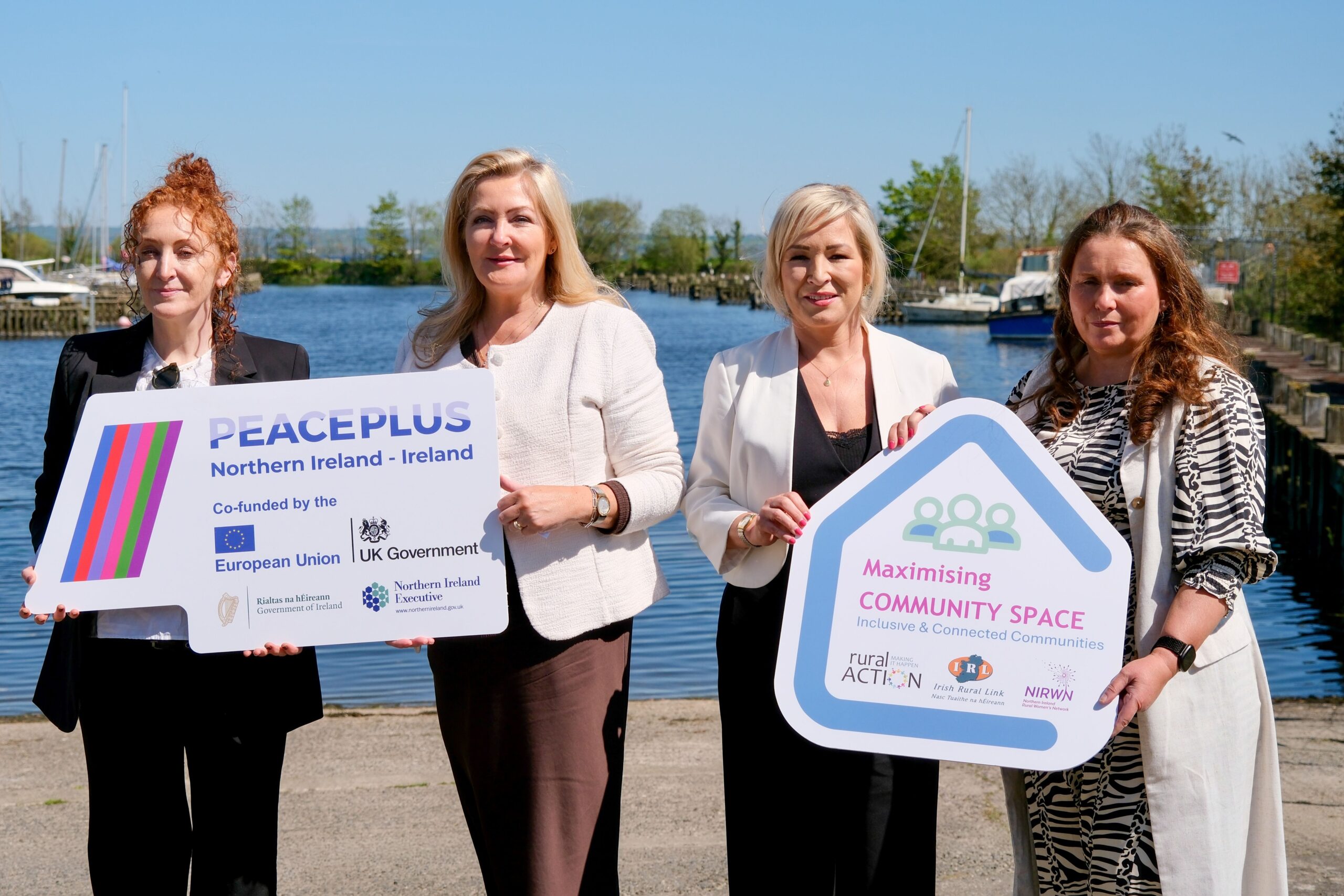
A major €2.75m investment in rural renewal has been unveiled with the launch of the Maximising Community Space (MCS) Project, a transformative initiative designed to support community organisations and people that manage halls, facilities and community spaces that bring people together.
The launch event at Lough Shore Marina Centre in Ballyronan was attended by guests and speakers including First Minister Michelle O’Neill, Linda Sheridan – Assistant Principal at the Department of Rural and Community Development and the Gaeltacht – and SEUPB Chief Executive Gina McIntyre.
MCS is a project supported by PEACEPLUS, a programme managed by the Special EU Programmes Body (SEUPB).
Rural Action is delighted to introduce this new cross‑community and cross‑border programme, which will support rural areas unlock the potential of their spaces, making them more inclusive, welcoming and better equipped to meet local needs.
Through the Maximising Community Space – Inclusive and Connected Rural Communities Project, partners aim to strengthen rural communities by providing training, networking opportunities, and practical support to help organisations enhance sustainability, expand income generation, and increase access to vital community services.
The project brings together a multi stakeholder partnership comprising of Rural Action who will lead the project along with partners, Irish Rural Link (IRL) and the Northern Ireland Rural Women’s Network (NIRWN).
Through networking, events and activities, MCS will encourage and facilitate collaboration between rural communities on a cross-border and cross-community basis. Participating groups and organisations will benefit from shared learning and tailored training designed to maximise income generation, strengthen long‑term sustainability, and widen access to essential community services.
The Executive Office has supported this project with over £350,000 of funding.
First Minister Michelle O’Neill said: “The Maximising Community Space project is a really positive investment in rural communities, with support from The Executive Office. Community spaces are where people meet, hold events, support one another and stay connected.
“This project will help local organisations make those spaces more welcoming and inclusive, while giving people the chance to learn new skills, build confidence and bring communities together. It is also really positive to see a strong focus on supporting more women into leadership roles.
“I want to thank Rural Action and all of the partners involved, and I wish them every success as the project gets underway.”
Deputy First Minister Emma Little-Pengelly said: “I welcome the launch of the Maximising Community Space project as it puts people and communities at the very centre and creates opportunities for people to come together, share their experiences and work together.
“By providing practical support, improving access to important community services and offering new opportunities that will meet local needs, this project will help to ensure our rural communities thrive.
“With a focus on leadership and inclusion, this project will help to build confidence in our communities and make a real and lasting difference to people’s lives as a result.”
The Minister for Rural and Community Development and the Gaeltacht, Dara Calleary TD, and Minister of State with Responsibility for Community Development and Charities, Jerry Buttimer TD, welcomed the announcement.
Minister Calleary said: “I wish to express my deep appreciation to everyone who has contributed to the advancement of the MCS project. It gives me immense pleasure that my Department of Rural and Community Development and the Gaeltacht, in conjunction with the Special EU Programmes Body and The Executive Office in Northern Ireland, will continue to provide assistance for this exceptional initiative.”
Minister Buttimer added: “This initiative encapsulates the essential components of the Building Positive Relations Investment Area through its diverse collaborations. It seeks to cultivate positive relationships marked by respect, enabling individuals to live, learn, and connect with each other, unburdened by prejudice, hatred, and intolerance.”
SEUPB Chief Executive Gina McIntyre said: “Projects like Maximising Community Space help create the conditions for continued progress – places where people feel safe, welcome and valued, and where relationships can grow naturally through shared experiences.
“PEACEPLUS will continue to support initiatives that empower communities, strengthen relationships and leave a lasting legacy of understanding and cooperation. Maximising Community Space reflects these aims perfectly – placing people at the centre of its work and helping rural communities create places where everyone feels they belong.”
Rural Action Chief Executive Teresa Canavan said: “The MCS programme brings together three innovative themes designed to strengthen and motivate rural communities. Through Inclusive Leadership & Development, we are equipping organisations and people with the skills, confidence, and capacity to develop and take forward meaningful inclusive leadership and succession plans for their respective areas.
“Inclusive Space focuses on existing and new activities identified to encourage shared usage of community spaces meeting local needs. And through the Connected Communities and Places theme, we are supporting and empowering communities to learn from others through study visits, case studies and building connections with other stakeholders.”
The MCS programme will open for expressions of interest from rural organisations wishing to take part on Friday 1st May 2026. Further information is available at www.ruralaction.co as well as on the websites of all programme partners. The programme is targeting the participation of 40 rural community-based organisations from rural areas in Northern Ireland and the border counties of Cavan, Monaghan, Leitrim, Louth, Donegal and Sligo. The closing date for receipt of applications is 19 June 2026.
The PEACEPLUS Programme has been designed to promote peace and prosperity across Northern Ireland and the border counties of Ireland, and has a total value of €1.14bn, to be delivered over the next four years.
PEACEPLUS is co-funded by the European Union, the Government of the United Kingdom of Great Britain and Northern Ireland, the Government of Ireland, and the Northern Ireland Executive.
More information on the project will be available at www.ruralaction.co
ENDS
Notes to editors:
- The Special EU Programmes Body (SEUPB) is a North South Body with the statutory remit for managing EU funding programmes within Northern Ireland and the border counties of Ireland.
- PEACEPLUS is a cross-border funding Programme designed to support peace and prosperity across Northern Ireland and the border counties of Ireland. The total value of PEACEPLUS is €1.14 billion.
- PEACEPLUS is co-funded by the European Union, the Government of the United Kingdom of Great Britain and Northern Ireland, the Government of Ireland, and the Northern Ireland Executive.
- Maximising Community Space – Inclusive and Connected Rural Communities (MCS) is funded through the PEACEPLUS Programme – Building Positive Relations – to the value of €2,753,293.
- The project is led by Rural Action and includes partner organisations Irish Rural Link, and the Northern Ireland Rural Women’s Network.
- Rural Action was formed in 2019 as a not-for-profit social purpose company and became a registered charity in March 2022. It was established to meet an identified need for a regional delivery organisation with a focus on supporting grassroots communities. It seeks to make a positive contribution to the everyday lives of rural communities, with an ambition to achieve this, not only through working with others, but as an organisation to give back, to support and inspire rural communities to design, deliver and implement practical projects.
- Irish Rural Link was formed in 1991 as a non-profit organisation, representing a national network of organisations of some 600 community groups with a combined membership of 25,000. With a focus on sustainable rural development, it seeks to support rural communities through a range of operational projects and programmes, through local community development approaches, engaging with key stakeholders and disseminating good practice at both a national and European level.
- Northern Ireland Rural Women’s Network was formed in September 2006 as a not-for-profit organisation and works regionally across NI with a membership base. With a focus on an equitable society where rural women are visible, influential and valued, it supports organisations and projects by providing advice, information, education and training, raising awareness of the needs and experiences of rural women